
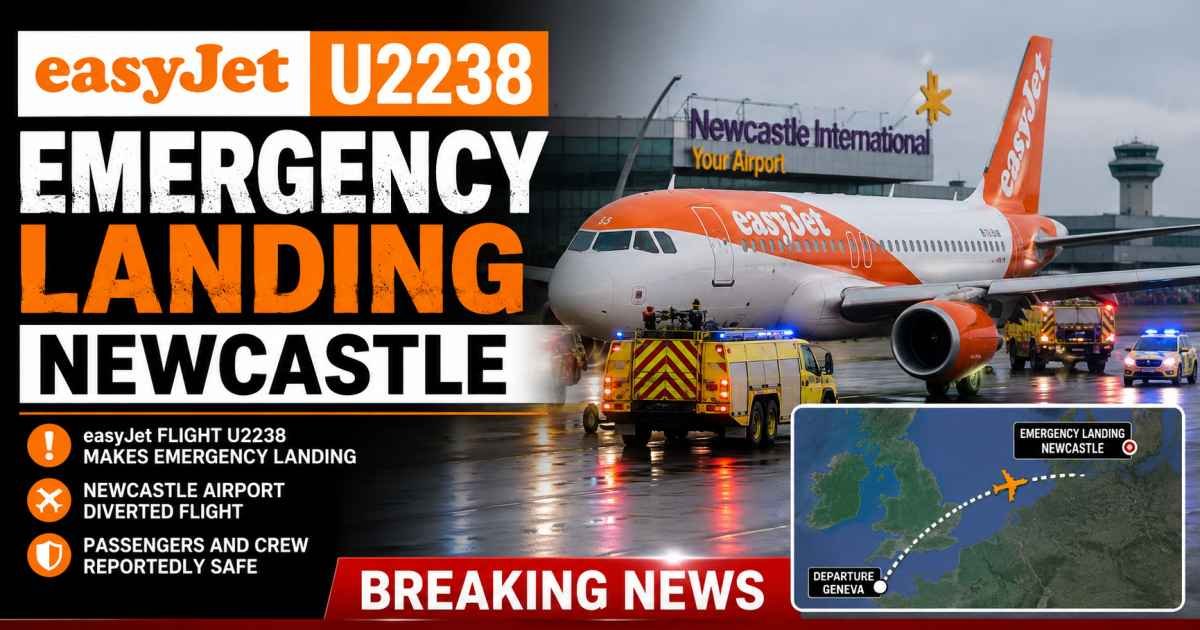
The search phrase “easyJet flight U2238 emergency landing Newcastle” has attracted considerable attention because it appears to describe an easyJet aircraft making an unexpected emergency landing at Newcastle Airport. However, there is an important flight-number clarification that should be made before discussing the incident. The October 27, 2025 event that generated these searches involved an easyJet service travelling from Copenhagen to Manchester, and available reporting identifies the aircraft as U22238/EZY2238, rather than the separate flight designation U2238. The confusion is understandable because easyJet uses the airline code U2, while aviation tracking systems commonly use EZY as the three-letter designator.
The incident itself was a medical diversion, rather than a confirmed aircraft mechanical failure. During the flight, a passenger required urgent medical attention, prompting the crew to declare an emergency and divert to Newcastle International Airport. The aircraft landed safely, emergency medical personnel responded on the ground, and the flight subsequently continued to Manchester. This article explains what happened, why Newcastle was selected, what the flight-number confusion means, and what can responsibly be said about the incident based on publicly available information.
Table of Contents
ToggleWhat Happened to easyJet Flight U2238?
The incident occurred on October 27, 2025, when an easyJet aircraft operating the Copenhagen-to-Manchester route was diverted to Newcastle after a passenger became seriously unwell. Rather than continuing toward Manchester, the pilots determined that the situation required the aircraft to land at an airport where appropriate medical assistance could be provided quickly. Newcastle was therefore used as the diversion airport, allowing emergency services to meet the aircraft after landing. Public reports indicate that the plane landed safely and that the passenger was taken for medical treatment.
It is important not to describe the event as a crash or imply that the aircraft suffered a catastrophic technical malfunction. The available reporting consistently describes the reason for the diversion as a passenger medical or welfare emergency. Some online articles have used dramatic language around the incident, but the confirmed outcome was considerably more reassuring: the aircraft reached Newcastle safely, medical responders attended the passenger, and the service was later able to continue toward its original destination. That distinction matters because an emergency declaration in aviation does not automatically mean that an aircraft is in danger of crashing; it can simply mean that the crew needs priority assistance because of an unexpected situation onboard.
Why Did the easyJet Flight Divert to Newcastle?
The primary reported reason for the easyJet Newcastle emergency landing was a passenger who required urgent medical attention. In commercial aviation, pilots have considerable discretion when deciding whether a medical situation warrants a diversion. They can consider the passenger’s condition, available medical advice, the aircraft’s position, fuel requirements, weather, airport facilities, and the distance to suitable airports. If continuing to the scheduled destination could unnecessarily delay treatment, landing earlier at an appropriate airport can be the safer decision.
Newcastle was a logical choice because Newcastle International Airport is a major UK airport capable of handling commercial aircraft and emergency diversions. Once the decision to divert was made, air-traffic-control procedures could prioritize the aircraft and coordinate the arrival with airport personnel and emergency responders. Reports of the incident indicate that medical personnel were ready to respond after the aircraft landed. The response demonstrates an important feature of modern aviation: an emergency does not rely solely on the pilots and cabin crew but involves coordination between the aircraft, air traffic control, airport operations, and medical services.
U2238 vs U22238 vs EZY2238: Why the Flight Number Is Confusing
One of the most important details for anyone researching easyJet flight U2238 emergency landing Newcastle is the flight-number discrepancy. The phrase U2238 is widely used in online searches, but sources examining the incident identify the Copenhagen-to-Manchester service as U22238, also represented as EZY2238. Meanwhile, U2238/U2 238 is associated with a separate easyJet service operating between Newcastle and Bristol. This means that simply writing “U2238” without explaining the distinction can unintentionally combine two different flight references.
The reason for the confusion is easy to understand. easyJet’s two-character IATA airline code is U2, so a flight numbered 2238 can appear as U2 2238, which when written without the space becomes U22238. Aviation tracking systems can instead use easyJet’s ICAO designator EZY, producing EZY2238. By contrast, U2 238 becomes U2238. The difference is only one digit in written form, but operationally these are different flight numbers. For readers searching the exact phrase “easyJet flight U2238 emergency landing Newcastle,” the safest explanation is therefore that the search term generally refers to the October 2025 Copenhagen-Manchester diversion, whose more precise identifier is U22238/EZY2238.
What Happened After the Emergency Landing?
After the aircraft arrived at Newcastle, the immediate priority was the passenger who needed medical assistance. Reports indicate that emergency personnel attended the aircraft and the passenger was transferred for further care. The remaining passengers were not facing the same medical emergency, and after the situation had been dealt with, the aircraft was able to continue its journey toward Manchester Airport. This is an important part of the story because it shows that the diversion was not necessarily the end of the flight or evidence that the aircraft itself was unable to continue operating.
For passengers onboard, an unexpected diversion can naturally be stressful. Even when an aircraft lands safely, passengers may have questions about why the route changed, whether another problem exists, and when they will reach their destination. In a medical emergency, however, the priority is the welfare of the person requiring assistance. Once that situation has been addressed and the aircraft is considered suitable to continue, the airline can resume the journey. The reported continuation to Manchester therefore provides useful context when evaluating the overall outcome of the easyJet U2238 Newcastle incident.
Was There an Aircraft Mechanical Failure?
Based on the publicly available reporting reviewed for this article, there is no verified evidence that a major mechanical failure caused the Newcastle diversion. The consistent explanation is that the aircraft diverted because of a passenger medical emergency. Some online articles have speculated about technical problems, but speculation should not be presented as fact without confirmation from easyJet, aviation authorities, investigators, or another authoritative source.
The fact that the aircraft later continued to Manchester is also consistent with the reported explanation, although it should not by itself be treated as proof that no technical inspection was necessary. Commercial aircraft can undergo checks after unexpected events, and the crew and airline can determine whether the aircraft is appropriate for onward operation. The key point for readers is that an emergency diversion and a mechanical emergency are not synonymous. In this case, the available information points to a passenger medical situation as the reason for the diversion.
What Does the Newcastle Diversion Tell Us About Flight Safety?
The easyJet emergency landing in Newcastle is also an example of how aviation safety systems are designed to work when something unexpected happens. Commercial aircraft routinely operate with procedures for medical events, technical problems, severe weather and other circumstances that may require a change of plan. When a serious situation develops, the flight crew can communicate with air traffic control, request priority handling and select a suitable airport rather than continuing with the original route simply because it was the scheduled destination.
For passengers, the most reassuring aspect of the incident is the sequence of events: the crew recognized that urgent medical assistance was needed, the aircraft diverted, Newcastle was able to receive it, emergency personnel responded, and the flight eventually continued. That does not mean every aviation emergency has a simple outcome, but it demonstrates why commercial aviation places such emphasis on crew training, communication, emergency procedures and coordination between airlines and airports. The goal of a diversion is not to create drama; it is to reduce risk by putting the aircraft and passengers in the best possible position when circumstances change.
Frequently Asked Questions About easyJet Flight U2238 and Newcastle
Why did easyJet flight U2238 land at Newcastle?
The incident commonly described as the easyJet flight U2238 emergency landing Newcastle involved a Copenhagen-to-Manchester service that diverted because a passenger required urgent medical attention. Public reports identify the aircraft as U22238/EZY2238.
When did the easyJet Newcastle emergency landing happen?
The incident occurred on October 27, 2025. The aircraft was travelling from Copenhagen to Manchester when it diverted to Newcastle.
Was easyJet U2238 actually the correct flight number?
There is an important distinction. The diverted Copenhagen-Manchester flight is more precisely identified as U22238/EZY2238. U2238 is a separate easyJet flight designation associated with the Newcastle-Bristol route.
Was the easyJet aircraft damaged?
There is no reliable evidence in the sources reviewed that the aircraft suffered major damage during the diversion. The plane landed safely and subsequently continued toward Manchester.
Was the emergency caused by an engine problem?
Available reports identify a passenger medical emergency as the reason for the diversion rather than a confirmed engine failure or other major mechanical problem.
Did the flight eventually reach Manchester?
Yes. After the diversion and medical response at Newcastle, reports state that the aircraft later continued to Manchester Airport.
What happened to the passenger?
Public reporting confirms that the passenger required urgent medical attention and was taken for further care. More detailed personal medical information has not been reliably established in the sources reviewed, so it would be inappropriate to speculate about the passenger’s condition.
Was this a crash or forced landing?
No. The aircraft diverted and landed safely at Newcastle Airport. An emergency declaration does not mean an aircraft is crashing; it allows the crew to receive priority assistance and appropriate airport support.
Conclusion
The story behind the search “easyJet flight U2238 emergency landing Newcastle” is less mysterious once the flight-number confusion is cleared up. The October 27, 2025 incident involved an easyJet Copenhagen-to-Manchester service identified more precisely as U22238/EZY2238, which diverted to Newcastle after a passenger required urgent medical assistance. The aircraft landed safely, emergency personnel responded, and the flight subsequently continued to Manchester.
The most important takeaway is that this was reported as a medical diversion rather than a confirmed major aircraft malfunction. It also highlights why accurate flight identification matters when researching aviation incidents online. While U2238 is the phrase many people search for, U22238/EZY2238 is the more precise reference for the Copenhagen-Manchester event. For readers trying to understand the easyJet U2238 Newcastle emergency, the available evidence therefore points to an unexpected passenger medical situation that was handled through a planned diversion and coordinated emergency response rather than an aircraft catastrophe.
